
Writing to Wound
Dane Giraud talks Nabokov, Free Thought, the Beauty of the Trap and the Trap of Beauty.

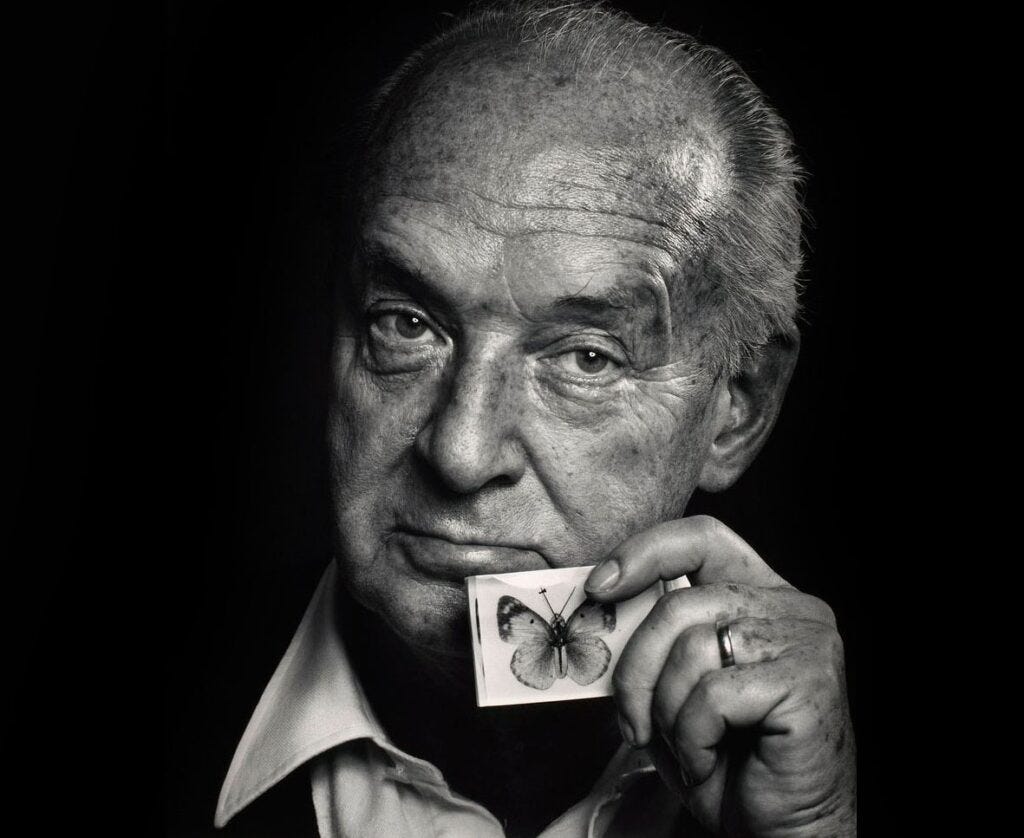
The best books do not solicit your comfort; they conspire against it. They are not gentle companions but ambush artists, laying snares in syntax, poisons in plot, and booby-traps in metaphor. The only surefire way to avoid their sting is the increasingly popular method: don’t read them at all. One is safer, after all, basking in the warm ooze of algorithmic affirmation.
But if you still possess the musculature for serious thought, that is, about art, about freedom, about the one domain where the intellect and imagination are supposed to cohabitate without surveillance, you must make a pilgrimage not to the sanitized temples of “inclusive storytelling,” but to the jagged cathedrals of the disturbing, the ambiguous, the irreducibly human. Vladimir Nabokov.
In our present epoch, this dolorous age of digital puritanism and semi-literate inquisitions, Nabokov perches like a defiant butterfly: exquisite, uncategorized, and serenely indifferent to your discomfort. He is not for the soft-palmed apostles of this tiresome therapeutic age. He is for those who understand that freedom of thought must include the freedom to shake up, to repel, and to seduce.
Born into the doomed liberal aristocracy of Tsarist Russia, Nabokov was a child of paradox: trilingual before puberty, politically literate before adolescence, and in exile before he had even reached full maturity. His father, a constitutional democrat assassinated while shielding another man from reactionary gunfire, imbued him with a sense of liberty that was not merely abstract but terminally urgent. Freedom, the elder Nabokov taught by martyrdom, is not a slogan. It is a duty, blood-soaked.
What followed for Nabokov was a life of exiles: from Lenin, from Hitler, and ultimately from the drab utilitarianism of mid-century American academia. He taught literature to students unworthy of him, hunted butterflies with rapture, and wrote sentences so aerodynamically exquisite that lesser minds have spent decades trying to shoot them down. That they are still banned and bowdlerized should tell you everything you need to know.
What makes Nabokov indispensable to the cause of free thought is his refusal to moralize. In an era when Stalinist commissars, Freudian charlatans, and evangelical simpletons all demanded allegiance, Nabokov chose none. He practiced aesthetic absolutism and moral ambivalence. Like Hitchcock and Sid Vicious, he was a lack-of-virtue signaller. He wrote not to instruct the proletariat, nor to soothe the bourgeoisie, but to enchant, and in doing so, he enraged everyone. As one should.
Though I started with Laughter in the Dark, consider Lolita, the book most discussed by people who haven’t read it and least understood by those who have. It is not a pean to paedophilia but a study in the psychopathy of charm, in the tyranny of eloquence, in the treachery of narrative itself. If you emerge from Lolita sympathizing with Humbert Humbert, then congratulations - you have fallen into the very trap Nabokov set for you. And unlike today’s authors, who affix moral instruction labels to their novels like health warnings on cigarette packs, Nabokov trusted you enough to risk your misunderstanding. What other choice does greatness have?
This is the fulcrum of the entire argument: that real literature offends because it must. It wounds because it respects your intelligence. It does not traffic in the counterfeit currency of “relatability” or “representation.” It traffics in beauty, terror, and contradiction, the very things the culture now seeks to red-flag, redact, or render “problematic.”
In Strong Opinions, Nabokov reminded us that literature was born not from the cry of truth but from the cunning lie. “Literature was born,” he wrote, “the day a boy came crying ‘wolf, wolf’, and there was no wolf behind him.” That is not a celebration of deceit, but of imagination, of the sublime capacity to invoke danger, to simulate peril, without being devoured by it.
Or take this dagger of a line from the afterword of Lolita: “For me, a work of fiction exists only insofar as it affords me what I shall bluntly call aesthetic bliss.” That bliss, the shimmer of perfect prose, is the very thing the moralists cannot tolerate. For it exposes their utilitarianism, their idea that style and substance are adversaries, that beauty cannot house the grotesque. Nabokov knew better.
The beauty is the trap. The true horror of Lolita is not in its subject but in its method: how easily language can excuse atrocity, how readily we yield to charm over conscience. An experiment? An elaborate prank? Both are healthier starting places than a product. So, commence your next script thinking you are fashioning a practical joke. There’s a girl in the cake - a grotesquely disfigured girl.
Happy Birthday, baby.
Start writing.
Dane Giraud
[EDIT ME] B
eginnings are hard. [EDIT ME]
A blinking cursor on a fresh blank page can be intimidating for even seasoned writers. Here are some tips from our Partnerships team on how to go about your first Substack post:
1. Why this, why now
Tell your readers why you are launching this space. What brought you here and what inspired you to do it now. Think of it as a mini personal manifesto.
2. What kind of community are you looking to build here
You are not just starting a newsletter when you start a Substack, you are starting a community. You are inviting people to subscribe to your thinking. What kind of space will this be?
3. Be specific
Readers love clarity. Be clear when you explain what they should expect: how often will you be posting? Can they expect certain posts on specific days? What will the free subscribers get? What does a paid subscription buy them? (You can list these benefits in bullets.)
4. Use an image and “subscribe” buttons
A picture will look nicer when you share the post on your social media (click the image icon in the editor to search for copyright-free photos), and it will give color to your archive as you build it.

[EDIT ME]“Subscribe” buttons (found in your editor under “Buttons'“) will make it easy for new readers to subscribe to your newsletter with one click.[EDIT ME]
5. Ignore our advice
There is no one true way to go about building a Substack. This is your playground, experiment with it. If you’re having fun, your readers will too.
(But trust us on the “subscribe” buttons!)