
See Everything, Understand Nothing
When did censorship die? In 1983...

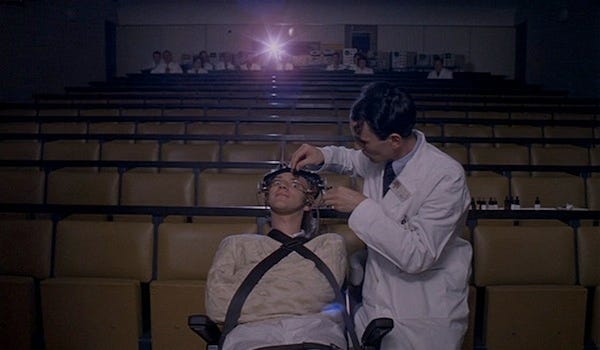
When I was a kid – this is in early 80s Otahuhu, South Auckland - I experienced both incredible freedom (in terms of extreme tree climbing and play without curfew) and a repressed media environment. When restricted films arrived in theatres, and if you weren’t old enough, you didn’t see them. Simple as that. The R18, or even R20 sticker, signaled a great Alsatian was somewhere in the dark and would ragdoll your scrawny body the moment you slipped inside that open exit door. I had to be content with studying images of A Clockwork Orange in library books, and would do so for hours, willing them to move. Gratification could take a decade in those days. You earned your sex and violence.
But then it all changed. The home video revolution, ironically marketed as “family entertainment,” was the beginning of the end of censorship for children. You’ll rarely hear this truth voiced by anyone, but it is the truth, nevertheless. Children haven’t really been censored since 1983.
Once the VHS player entered the lounge, the machine took over from the cinema worker, parent, teacher or community worker. It was extremely dispassionate about your age or welfare. Also, it didn’t report back to anyone, which was the culture of South Auckland anyway, so I took this aspect of its character for granted. It just quietly whirred (though in my ears I heard the final spirited drumroll designed to convince a stripper to drop her last folding fan), clicked, and delivered whatever was magnetically imprinted on the tape.
That really was it.
After VHS even the cinema owner dropped the velvet bollard. Confident that we’d already seen heads explode in David Cronenberg’s Scanners at a mate’s house, what harm could our watching A Nightmare on Elm Street do? The damage, surely, was done?
By 1983, the censor’s office was a decorative relic. Its stern judgments meant nothing. Before the internet had even arrived, I had consumed all the celluloid contraband I had longed for as a child in that library.
Today, with the internet, this 45+ year trend continues. Children today have never been so surrounded by adult material. And yet censorship is alive and well: only not for children, but for adults.
We now police speech, jokes, language, and the opinions of big people. The child is now the freest consumer in the house. The adult, by contrast, must navigate a labyrinth of content warnings, sensitivity readers, and moral adjudicators in HR departments. The inversion is total: the moral panic has shifted from the family living room to the university faculty lounge. And many of us take it.
When the VHS player first appeared, it promised freedom. And it delivered. But like every liberation, it had a shadow. The old paternalistic structures, for all their flaws, at least implied a hierarchy of development: that there were things you weren’t ready for yet. That moral or aesthetic growth was a process. Remove the process, and you remove the initiation. My long preparation for A Clockwork Orange, simply wouldn’t – couldn’t – take place anymore.
You could frame censorship, not only as control, but as a type of cultural scaffolding - a way to prepare the young for the shocks and contradictions of being human. The promise of the perverse is important. But it has to stay a promise at least for a period. Because what do we have now? A few generations who have seen everything but understood nothing.
While I decry censorship in general, there is something to the cultural scaffolding argument. Having a generally agreed sense of what media children should be engaging with is socially useful, but responsibility should fall on the parents and not be imposed on the rest of us. My family used the censorship office warnings as a loose guide, but even as a child growing up in the 2000s I still had to sneak in to see District 9 in theatres because of the age rating.