
Parents Can’t Be Trusted
Whether the Bolshevik Nursery or New Zealand’s Social Media Panic the state has no business parenting on our behalf.

Against a vast, burnt-orange sky - a sky so lurid and apocalyptic it feels painted in napalm - a formation of UH-1 Huey gunships rises in silhouette. They hover at first, side by side, black shapes carved cleanly against the blazing horizon, their rotors slicing the air with the mechanical disregard of ravenous insects.
As the sun bleeds into the frame, the choppers appear almost mythic: part cavalry charge, part Wagnerian hallucination. And inside each of these steel Hawks - a determined Grey Lynn mother, hair tied back, reusable coffee cup in the holder, ready to set the friendships and community, and hobbies and interests of our nation’s adolescence ablaze for their own protection.
The helicopter parent has returned. And this time she means business…

I noticed I’ve developed a strange little tic whenever I talk about National’s proposed under-16 social media ban: I keep insisting it’s being advanced with “good intentions.” It’s the kind of instinctive throat-clearing people use before touching any issue involving children - a way of radiating goodwill lest anyone accuse you of cruelty.
But the truth is, I don’t truly believe it. I don’t think the intentions are good.
At all.
Because a ban sold as “helping families” is, in reality, a vote of no confidence in those same families.
Reality-TV personality Matilda Green emerged from a podcast with Christopher Luxon, announcing on Instagram: “It (the bill) really has been driven by mothers… it’s a mothers’ rebellion.” Luxon clearly feels he needs the well-off censorial female vote - normally wedded to Labour. They are noisy - can always get the ear of the media - and will give him faux-progressive bona fides. But this whole thing makes little sense. If these self-declared rebel mothers were so concerned about social media, why haven’t they used any of the vast array of tools that already exist to restrict their children’s online habits?
The answer floats up with remarkable clarity: these mothers don’t trust your parenting. And neither, probably, does the government.
I detest governments elbowing their way into my living room. And not from a Family First vantage point. I grew up in a broken home, and I’ve been a solo father for more than a decade. I’m not defending any sepia-toned domestic utopia. I’m defending the right of families - broken, scruffy, patched-together - to be imperfect without having their authority confiscated by politicians who can’t keep the country solvent, let alone raise a child.
Social engineering is what governments reach for when they’ve run out of anything material to offer. The imported identitarianism of the modern Left served the same function: a distraction from class concerns. Now the government is importing a digital panic to divert attention from falling home ownership, rising rents, and a cost-of-living crisis that is pulverising households.
If you can’t keep the country from going broke, you can at least scold parents about screen time.
Now for the ungenerous reading.
The political class has always resented the private home. It is the one place where unapproved loyalties form. Where affection trumps ideology. Where people behave according to quirks, passions, and resentments rather than party lines.
Early communist theorists were obsessed with this problem. Engels, social engineer-in-chief, declared the family a capitalist contrivance: abolish private property, and the family dissolves. Children would become communal projects, and women would be liberated from “domestic serfdom.” Privacy was to evaporate into mist.
Then came Bolshevik thinker Alexandra Kollontai, who made Engels sound like Susy Cato. She fantasised about “winged eros” - love without exclusivity, jealousy, or monogamy - supported by communal childcare. Emotional life reorganised. The family was dismissed as a petty-bourgeois relic.
Leon Trotsky was on board, though he viewed the dissolution of the family as something that wouldn’t require force of any kind. He mocked the “stuffy, stagnant family hearth.” To him, collectivised kitchens were portals to a new democratic dawn.
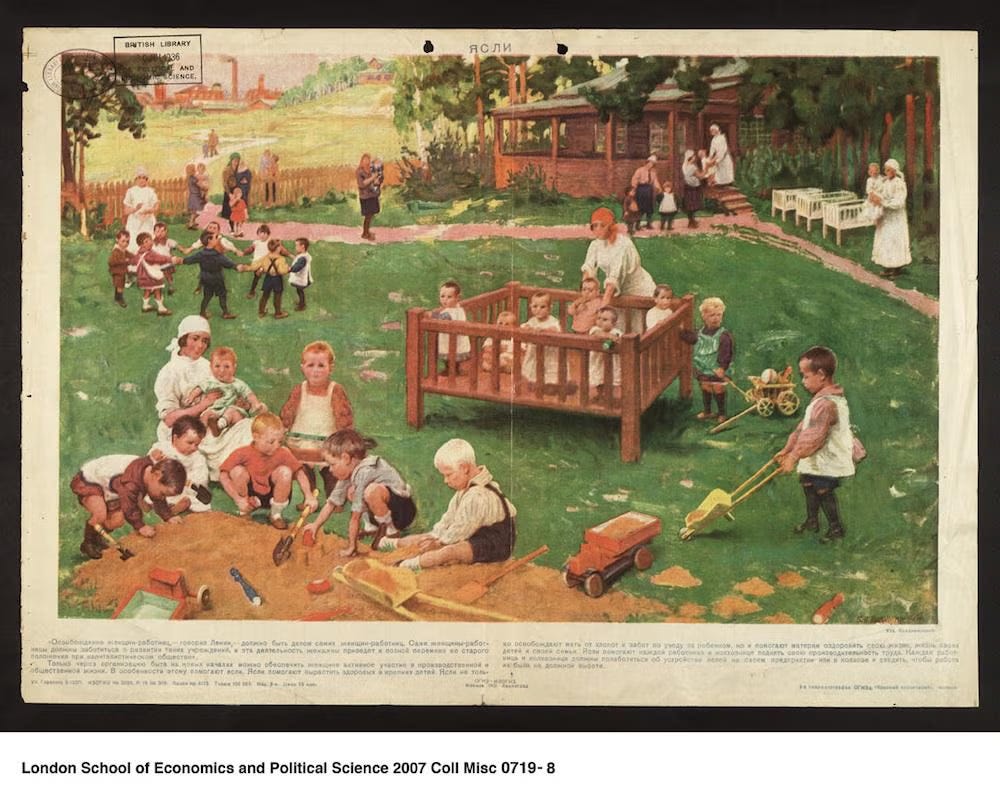
What unites all these luminaries is their staggering cluelessness about actual human beings. None of them could make room for the messy, irrational, impossible-to-quantify intimacy that makes family life real. They wrote as if describing a kiss, only from having read about one in a manual.
But doesn’t the Under-16 social media ban reflect the same suspicion of the private home and paint humanity with the same beige brush – only this time not through revolutionary pamphlets but affluent “rebel mums” who believe their philosophy should be imposed nationwide? Understand this: censorship never comes from the bottom. It is always the well-off instructing everyone else as to why they’re wrong. Point me toward any would-be censor who - as an act of goodwill - pledged to shut up first. You will not find one.
And if we’re concerned about harms, why not address poverty? A harm that is real, measurable, consistent - unlike the murky, endlessly inconclusive research on digital harms. Poverty shapes a child’s life far more reliably than TikTok ever could. But if poverty doesn’t exist in your world, then, conveniently, neither does the obligation to solve it.
Which brings us to the most grotesque element of the “mothers’ rebellion”: its impact on kids who don’t live in the bubble. The curious, sophisticated fourteen-year-old girl from Māngere East - bright, ambitious, culturally omnivorous - who has linked herself to new friends abroad through shared interests, music, politics, humour, and the thousand tiny affinities that make the online world liberating for those outside of privilege?
She now has to sit and wait.
Wait until the government decides she is mature enough to resume a global friendship circle that cost her nothing and enriched her life enormously.
Why?
Because a mother in Herne Bay - with the resources to micromanage her children’s every moment - even hand them off to hired help - has decreed, via the Prime Minister, that the entire country must adopt her anxieties as law.
But criticise this bill soon, and you’re likely to be accused of misogyny. That’s coming. We defy a self-declared mothers’ rebellion at our own peril. But it’s fathers that have always taught risk. After years of helicopter parenting, the internet was the one place that gave children a little oxygen. That oxygen is now being siphoned off “for their own good.” That rhythmic whoosh-whoosh you hear? That’s the Helicopter parent warming their engines. They are set to rise again over a burnt-orange sky.
Triumphant.
Despite the clear benefits to under-16s from many kinds of online contact, I'd have thought that online bullying might be a concern. Not sure that that is something that adolescents always 'fess up about, to their parents, or not at least till it's become toxic.. That is, the question of under-16s and the online environment might be a difficult issue which isn't resolvable by generalities about social class and the supposed intentions of governments. Will be interesting to see how the Australian legislation works out.
Right on! These 'helicopter mothers' need to learn how the Internet works. Maybe the government could educate these hysterical bourgeoise types about all the safety features already available? It would be a lot cheaper than implementing a Social Media Ban, and it would stop these 'perfect families' from telling the rest of us how to live...