
Hostile Takeover
Dane White's vision for boxing will be like inviting the pickpocket to run the coat check and telling the patrons their wallets have never been safer.

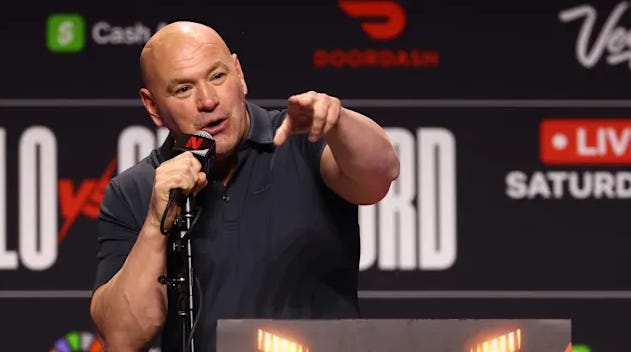
As much as I am looking forward to the Canelo-Crawford fight, I find myself having to repress any thought of UFC mogul Dana White’s involvement, like a bad experience with an uncle in a garden shed. A punk is coming for boxing, and while this may mean short-term gain for fans, the cost to boxers could be, well, criminal.
Boxing has never been the Rotary Club. It has always been a trade, a hustle, a blood-drenched carnival where the violence in the ring is rivalled only by the venality outside it. From Don King’s hair-raising contracts to the alphabet soup of sanctioning bodies - WBC, WBA, IBF, WBO (WTF) - each demanding its pound of flesh, the sport has been marred by fixers, grifters, and “advisors” who regard fighters less as athletes than as walking, talking lotto tickets.
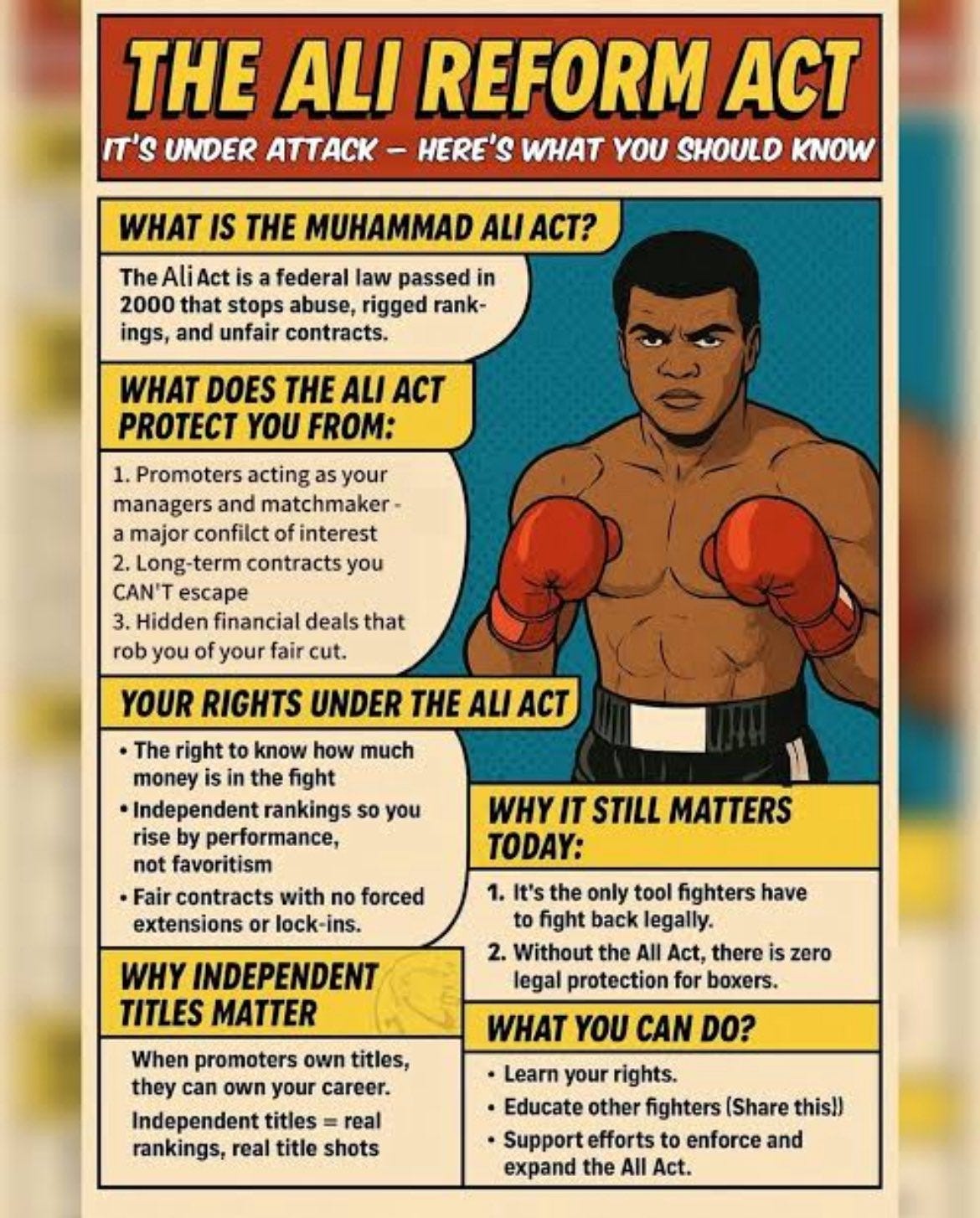
It was in recognition of this centuries-old swindle that the United States passed the Muhammad Ali Boxing Reform Act in 2000. The law was not revolutionary; it was a set of simple guardrails. It said: promoters cannot also be managers, rankings must be transparent, fighters must be told how much everyone else in the room is getting paid, and sanctioning bodies cannot be bought and sold like junk bonds. Its purpose was modest but crucial – to protect the fighters from the worst predators in the business.
Enter Dana White. White, for those fortunate enough not to know, is the man who turned the UFC from a violent novelty sport into a multibillion-dollar franchise. A carnival barker with a shaved head, or casino pit boss in a designer hoodie, White’s genius is less about building a sport than locking it in a cage, literally and figuratively. Fighters under UFC contracts are famously shackled to restrictive deals, unable to box, unable to negotiate, and often paid a fraction of what their boxing counterparts earn. White calls this efficiency. Others call it serfdom.
Now he wants to do the same to boxing.
White has partnered with Saudi Arabia’s Turki Alalshikh and the TKO Group to create Zuffa Boxing, promising to fix the “broken” fight game. His pitch is disarmingly simple: too many belts, too much chaos, not enough clarity. He will build a league, crown definitive champions, and give fans what they crave - “the best fighting the best.” It sounds wonderful. It is also nonsense.
Why? Because to do this, White wants to gut the Ali Act. His allies are pushing what is being branded the “Ali Revival Act,” a grotesque parody of reform that would allow “Unified Boxing Organizations” to control rankings, belts, and promotion under one roof. This is exactly the kind of conflict of interest the original Act was designed to prevent. It is like inviting the pickpocket to run the coat check and telling the patrons their wallets have never been safer.
Dana White is not a reformer; he is a monopolist. The UFC’s model has always been about centralisation: one boss, one brand, one set of rankings, all controlled from the top. Fighters are locked in, revenue flows upward, dissenters are told to take it or leave it. Apply that to boxing, and you do not cure the disease, you institutionalise it.
Look at his record. UFC fighters have staged public revolts over pay, healthcare, and lack of freedom. The heavyweight champion Francis Ngannou walked away from the company altogether, saying he felt like “a slave.” Others have complained that they were threatened with career exile for seeking better deals. White’s answer is usually bluster - “This is the fight business,” he says, “you don’t like it, don’t fight.” Imagine that ethos imported into boxing, where careers are short, damage is permanent, and transparency is already hard won.
The Ali Act was meant to shine a light into dark rooms. White wants to switch it off. At a press conference for the Canelo-Crawford fight - the jewel of his new venture – reporter Sean Zittel dared to ask about the Act. White snapped, called him an “asshole,” and refused to engage. That is not the behaviour of a man confident in reform; it is the tantrum of a punk who resents scrutiny.
Boxing fans, burned for decades, are understandably tempted by the promise of order. But order under Dana White is not liberation; it is cartelisation. It is the replacement of many flawed actors with one unaccountable kingpin. When he says, “best will fight the best,” hear instead: “fighters will fight when and how I tell them, for whatever I decide to pay them.”
The lesson of the Ali Act is that boxing needed protection from exactly this arrangement. White now offers himself as saviour by demanding that those protections be dismantled.
In the end, the question is simple: do we want boxing to be messy, plural, and at times corrupt - or tidy, centralised, and corrupt by design? Do we want a reliable, clear competition, only at the expense of fighters’ pay packets and safety? In both cases, White offers the latter. He’s the disease, not any sort of cure.
Agreed!
What did you think of the fight BTW? Sad to see Canelo just unable to pull the trigger these days. He used to be a multi-phase boxer, who would fight in combinations and beyond the first exchange. But then he developed power and switched to a jab-less, walk forward and throw unexpected, naked power shots type of fighter. He doesn't fight in multiple phases now, he throws a single exchange, resets, throws a single exchange, resets. Where as Crawford could fight past the initial exchange, not needing to reset every time before engaging again, because he doesn't get out of position while throwing like Canelo now does. It worked for Canelo for a while, but it certainly isn't now.