
Getting Into Debt to Be Misinformed

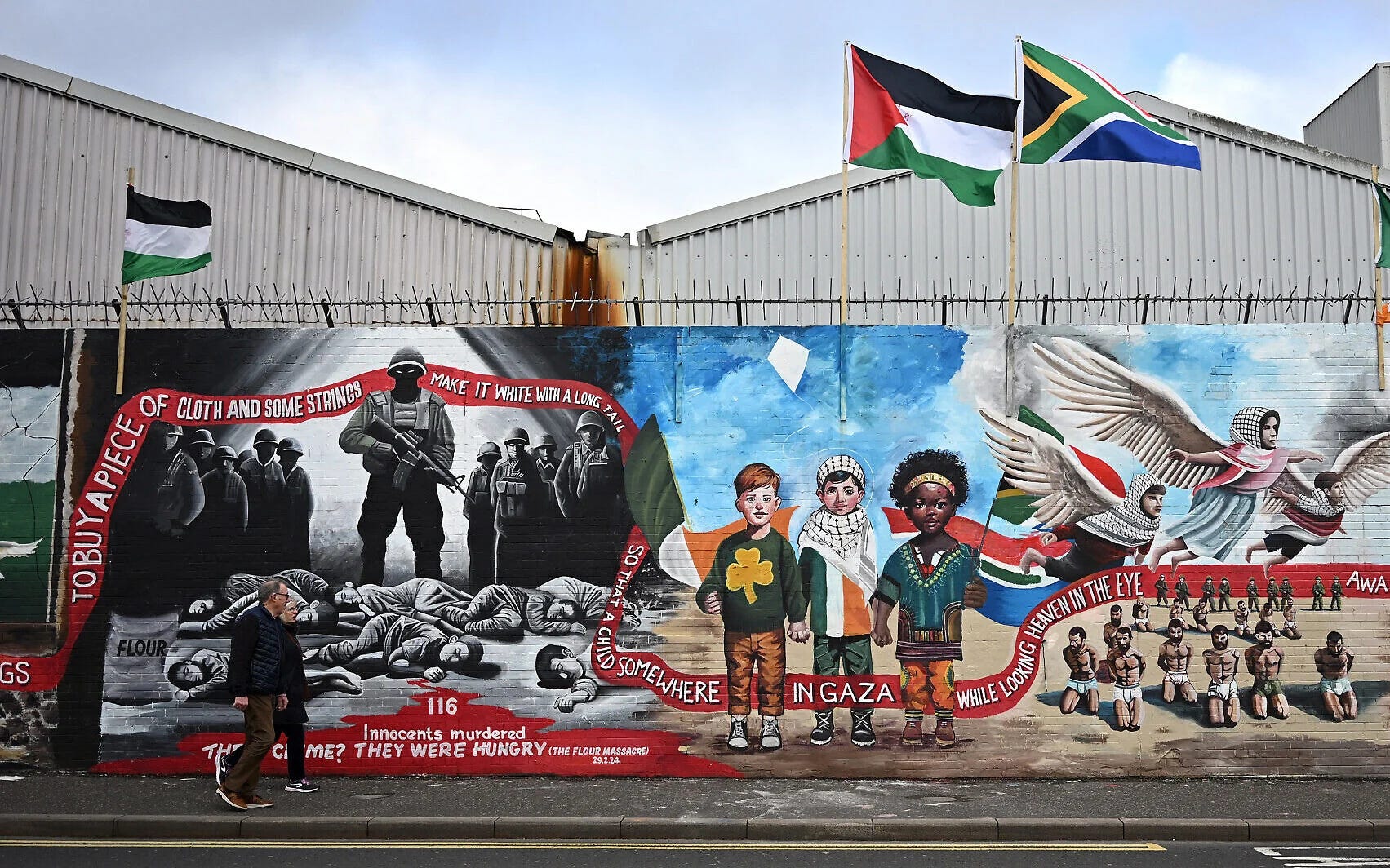
Associate Professor Sean Phelan of Massey University has penned what he believes to be an efficacious comparison between the foreign policy priorities of Ireland and New Zealand. His ostensible goal is to contrast the Irish Government’s moral clarity on Gaza with what he frames as the evasive cowardice of Winston Peters and the New Zealand Government. We’re told by the Associate Professor that his slam-dunk of an indictment was presented in lesson form to fee-paying students on the dreary plains of Palmy.
https://www.massey.ac.nz/about/news/opinion-the-new-zealand-government-and-the-silence-over-gaza/
The Irish Prime Minister, we are reminded, has condemned the Israeli blockade as a war crime; Irish Foreign Minister Simon Harris tweets frequently about Gaza, appears on popular talk shows, and reaffirms Ireland’s commitment to Palestinian solidarity in every available medium. Winston Peters, by contrast, is too busy decrying “wokeness” on X to lift a diplomatic finger or moral eyebrow over the war in Gaza.
The late Kingsley Amis once remarked that “if you can’t annoy somebody, there’s little point in writing”. Dr Sean Phelan has certainly managed to irritate me, mainly by publishing his piece on the blog of Massey colleague Professor Mohan Dutta, a chap compact in frame but expansive in antisemitic bluster, who hailed the 7 October Hamas-led pogrom as a “powerful exemplar of de‑colonising resistance,” complete with an explicit statement of “solidarity” for the atrocities - culture-centered.blogspot.com. Thus, the good doctor Phelan’s lecture on New Zealand diplomacy begins in a swamp of blood‑spattered euphemism.
And yet Phelan’s bad faith is just putting on its boots. He completely ignores that Ireland is militarily neutral, unlike New Zealand, which aligns with our traditional allies. Although in rhetoric and action, Ireland is not neutral at all, recognising a Palestinian state unilaterally, backing South Africa’s genocide case against Israel, and goading Jerusalem into closing its embassy on Irish soil - the first such diplomatic freeze with an EU member in modern memory. While most of Europe contents itself with stern notes to Tehran about uranium enrichment, Dublin has chosen to play quarter‑master to the Hamas‑Hezbollah‑IRGC narrative factory. How could a serious, professional intellectual overlook this? How indeed.
Phelan also expresses dismay that Winston Peters and his ilk dare to use the term “woke” as if it were a pejorative. Phelan would have us believe that the anti-woke rhetoric deployed by Peters and others is simply a copy‑paste job from the U.S. right wing, cynically repurposed to silence any Palestinian solidarity. This is more distraction. What he fails to acknowledge is the very activists he romanticises, who openly voice support for theocratic fascism. In Auckland, Green MP Chlöe Swarbrick led chants of “From the river to the sea, Palestine will be free” - a slogan that, for all its soft‑focus invocations of liberation, is taken from the Hamas charter and is understood, correctly, as a call for the eradication of Israel. She also refused to call Hamas terrorists in the immediate aftermath of the Oct 7 pogrom and faced no censure from within the movement for it. And explain the use of “resistance” by so many white-to-translucent protesters, to explain away the crimes of Oct 7, if their professed stance is anti-war?
What we are left with is a sobering irony: in Phelan’s world, the government’s failure lies in its reluctance to speak. Yet what he advocates is not really speech at all but a new putrid orthodoxy, one in which protestors who praise terror groups are heroic dissidents, and those who question them are crypto fascists. The truth is that Winston Peters, vulgar and brash as he may be, has done something more intellectually honest than Phelan and his academic enablers. He has named the ideology for what it is. He has called out the pseudo-revolutionary cosplay of university protestors who talk of freedom while marching in lockstep with Iran’s military objectives. He has identified the selective moral outrage that screams for Gaza but mumbles through every massacre of Israelis and Arabs in other conflicts, many but a day’s drive from Tel Aviv. He has recognised the cynical sleight-of-hand that has turned “woke” from a term of empowerment into a shield for barbarism.
If Dr Phelan truly wishes to teach his students something about international communication, he might begin with the simplest rule: credibility matters. One cannot posture as a defender of international law while publishing on the blog of a man who cheered on a pogrom. One cannot invoke peace while praising those who deliberately prolong war. One cannot present oneself as a neutral observer while championing one side's propaganda wholesale and ignoring their crimes entirely.
And shout out to the poor students of Phelan who have gotten themselves into debt to be misinformed.