
Democracies Are Not Monasteries
Research suggests less speech means more violence. So why do those in power still want us to shut up?

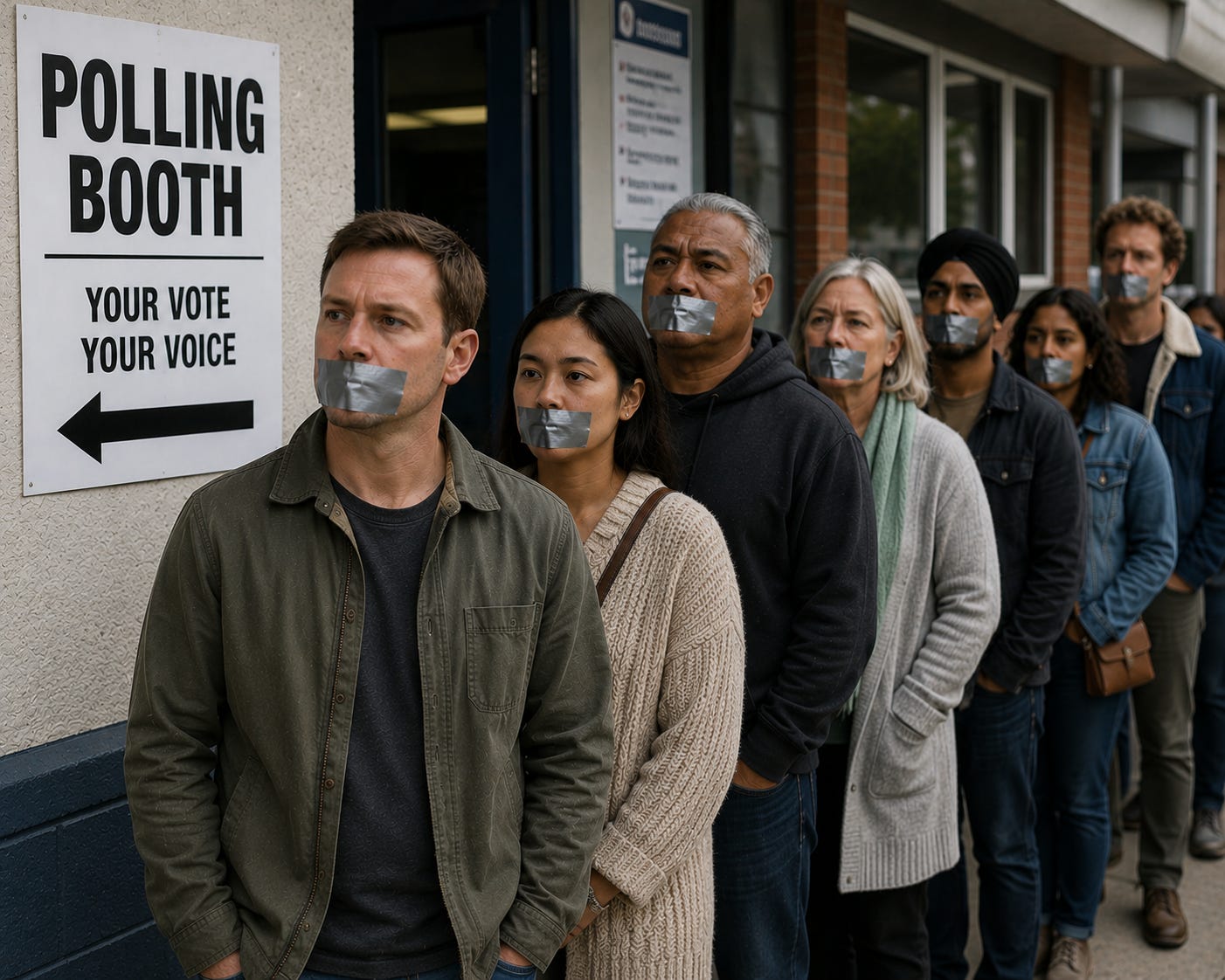
A frequent landmine in contemporary debate is the refusal to distinguish between explanation and endorsement. A few days ago, I posited where political rage comes from and was accused of cheering it on. From a no-name anonymous account, I would expect this. From a senior mainstream journalist like Christchurch-based Philip Matthews, my reaction was one of disappointment at our 4th Estate and its increasing inability to interpret disagreement in good faith.
Last week, NZ Green MP Tamatha Paul appeared before the Mana Wāhine inquiry and described the torrent of abuse directed at female politicians. Some of it was grotesque, threatening, and plainly unacceptable. Criminal. I never pretended otherwise. But the public discussion around this issue immediately lurched toward a familiar and dangerous proposition: that restrictions on speech are therefore required to protect democracy from its own citizens.
My response online was to point out something I would have thought almost embarrassingly obvious: politicians wield immense power over the lives of ordinary people. Jacinda Ardern’s government, for instance, presided over policies during COVID that left many New Zealanders unemployed, socially isolated, estranged from family, or publicly stigmatised. Whether one believes those policies were justified or not is beside the point: exercises of state power will inevitably generate anger. Democracies are not monasteries, and citizens are not emotional support animals for politicians. Public fury is part of the political process itself.
When Tamatha Paul cites being called a “racist pig” as evidence of abusive discourse that demands criminalisation, it is wholly legitimate to ask where the line between insult, political opinion, and genuine intimidation actually sits. Particularly when leaders within her own political movement appeared extraordinarily reluctant, in the aftermath of October 7, to straightforwardly condemn Hamas terrorism. Many Jewish New Zealanders experienced that equivocation as morally grotesque. Are citizens forbidden from expressing revulsion in harsh language? Must every emotionally charged political judgment now be calibrated for the emotional comfort of politicians?
Would the same people calling for censorship to address this also support criminalising Māori protesters for impassioned opposition to ACT’s Treaty Principles Bill? I put this question to Philip Matthews, but he did not engage with it. That omission matters because these debates cannot be confined to one side of politics. Once states begin regulating emotional or offensive political expression, those powers inevitably expand beyond their original moral framing.
My actual argument was straightforward: free societies require outlets for grievance. Speech is one of those outlets. Remove legitimate avenues for emotional and political expression, and resentment does not disappear - it festers. History and research suggest that societies that suppress speech in the name of harmony frequently produce something far uglier. Violence becomes statistically more likely, not less. I was arguing, quite literally, for free speech as an alternative to escalation.
https://www.journalofdemocracy.org/articles/fighting-terrorism-the-democracy-advantage/
And yet, Matthews interpreted this as a justification of “abuse and threats” and even, quite incredibly, accused me of “stochastic terrorism”.
To explain why anger exists is not to endorse criminal conduct. To defend broad speech protections is not to side with those who use threats. To observe that repression can intensify instability is not to invite violence. One might as well accuse a criminologist of supporting murder because he studies the causes of homicide.
All this matters because the stakes extend well beyond one ugly online spat. There is a growing impulse among political and media elites to redefine democratic anger itself as a social pathology requiring management. Sharp criticism becomes “harm.” Insults become “violence.” Emotional reactions to political decisions become evidence of extremism. The citizen is subtly recast not as a participant in democracy, but as a behavioural problem to be regulated.
Part of the problem may be that sections of the contemporary professional class no longer meaningfully experience the kinds of economic, social, and institutional dislocation that generate democratic fury. They encounter it instead as something abstract, unruly, and vaguely threatening - a phenomenon to be managed and erased rather than understood.
But democracies are, and must remain, noisy, abrasive things. Citizens sometimes speak crudely. They become angry when they lose jobs, status, freedoms, or faith in institutions. The answer to this has never been to criminalise emotional expression or place politicians inside a protective cocoon of speech restrictions. Indeed, one suspects (and the aforementioned study seems to conclude) the opposite is true: societies remain stable precisely because people are permitted to vent fury through words instead of being forced into silence.
That was never a defence of threats. Threats are criminal. It is an argument against confusing democratic speech with violence merely because that speech is emotionally unpleasant or politically inconvenient. This is the debate I wanted and never got.
I have previously written about the corrosive effects of online anonymity and argued that being forced to speak under one’s own name would likely improve public discourse considerably. Many free speech advocates would reject such a trade-off, and I understand why, but the fact that I went to the trouble of steel-manning the anti-anonymity argument proves I recognise, and have grappled with, the problem of abuse that female politicians face. What I fear is setting conditions - through censorship and the narrowing of legitimate expression - that ultimately make politicians like Paul, and democracy itself, far more vulnerable.