
After "After The Dream"
A response to William McGimpsey's essay "After The Dream" that critiques - and calls for the elimination - of the wins of the civil rights movement.

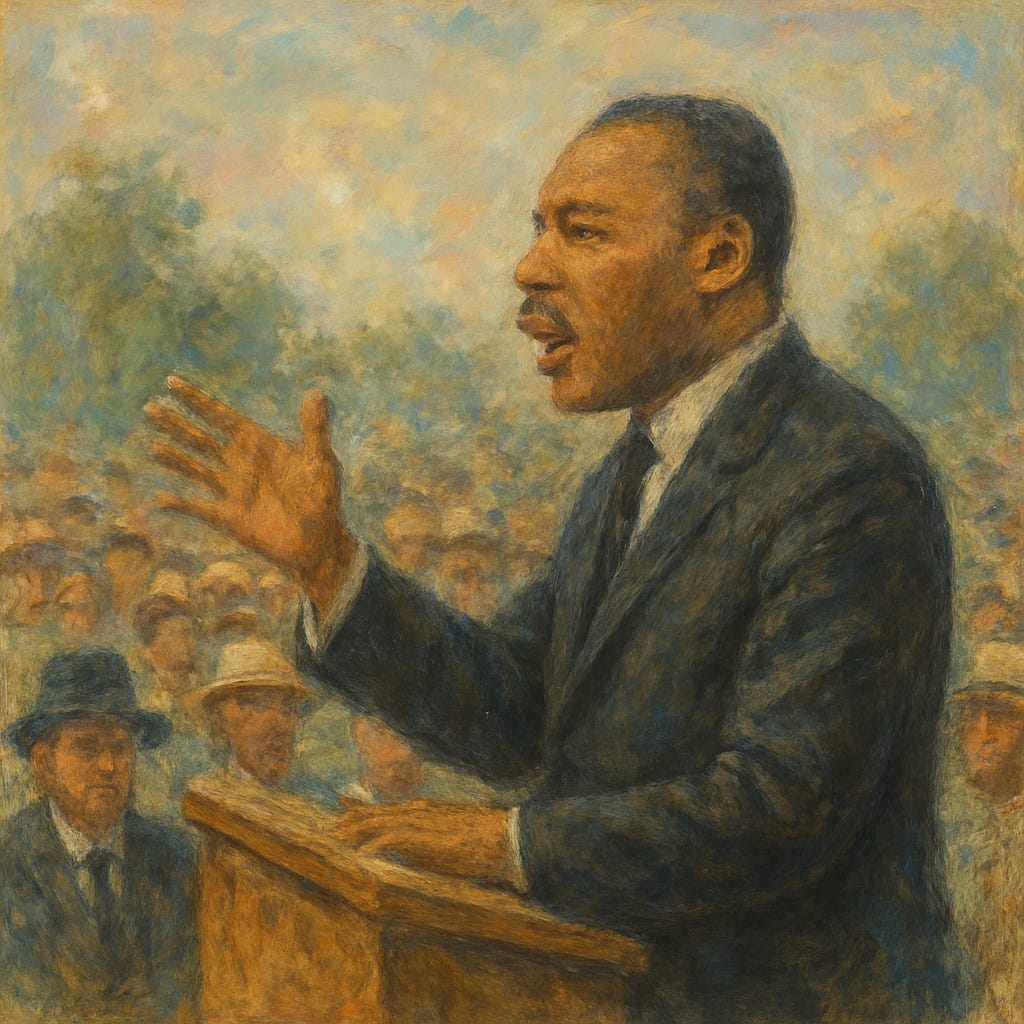
The perverse irony of messianic movements is that they are attempts to march backward into the future. Our own Jewish Messiah (the concept was never my cup of tea) was, at its heart, the cult of David, the last king who, coquetries aside, held the Israelite people together. Political Islam, even Obama’s early comparisons to Kennedy fit the messianic brief - We had it good, we no longer have it good, let's turn back the clock.
Social commentator William McGimpsey’s essay After the Dream sits squarely in this all-too-human tradition: his “dream” is a, at the very least, far whiter New Zealand, stripped of much of the state, and restored to some imagined ethnic and religious cohesion. His thesis is detailed and written with conviction, yet ultimately reaches for a phantom. To summarise, McGimpsey claims the U.S. civil rights movement curdled into tyranny through equality laws that gave rise to a “managerial society.” We, now, most of the West, live under this soft despotism of inclusion. His remedies, from remigration policies to the reinstatement of public Christianity, are pitched as vital to a grand restoration. But even if the majority of people wanted this, can a country be restored, and remain a democracy?
McGimpsey opens by taking aim at Martin Luther King, an odd target considering King would have likely agreed on the cynicism of today’s human rights industrial complex. Accusing King of twisting the Declaration of Independence (“We hold these truths to be self-evident, that all men are created equal.”) Jefferson, McGimpsey insists, was celebrating a break from Britain, not drafting a blueprint for social justice. No doubt. But the rhetorical wizard, whose stock and trade is to always put irony to good use, saw what Jefferson, a man of his age, was blind to: a nation of slaveholders proclaiming universal liberty. The work was unfinished, and the struggle unavoidable, because freedom is not some static state or a final destination - it propels a society forward, forever, whether its architects like it or not.
According to McGimpsey, what followed King was simply too much equality, resulting in the loss of rights and sidelining of tradition, overseen by a new managerial state: speech codes, DEI offices, and bureaucracies regulating thought and association. But the bureaucratisation he despises is not the product of egalitarianism but a revolt against it – a type of progressive Jim Crow – an attempt to grab a hold of the reins of a runaway horse by the neoliberal elite who, too, found equality inconvenient. This soft despotism of inclusion McGimpsey fears, is better understood as a progressive veneer over structures designed to control access to labour, manage compliance, and protect managerial prerogatives. And Martin Luther King wasn’t blind to this impulse among white allies. In Where Do We Go from Here: Chaos or Community? (1967), King warned that America must move “beyond a paternalism which believes it can set the pace for another man’s freedom.” He saw in the liberal establishment a desire to manage rather than emancipate. “We are integrating into a burning house,” he told actor/ singer Harry Belafonte. As a Jew, I see a similar paternalism in Israel/ Palestine commentary (I call it a “Crusader mindset”), in which more affluent whites seem uncomfortable with Jewish autonomy above everything else. The problem, in short, was not equality itself, but that it had been ceded to administrators rather than lived and enforced by the people. King’s vision was moral, not managerial - a democratic universalism, not a checklist of quotas. But, as in the time of the original Populist Party, rich whites still feared black and white workers finding common cause. King – sympathetic to working poor whites - made this observation too, in his critique of Jim Crow given at Selma. One take on today’s “wokeness” (and I would suggest an incisive one) is that it is an elaborate project to convince racial and sexual minorities that rich whites make better friends than poor whites. How exactly would more whiteness, McGimpsey’s overall solution, address that - beyond there being fewer minorities for them to exploit?
McGimpsey’s critique of equality extends to the moral reconfiguration of society. McGimpsey laments the rise of rights for women, LGBTQ+ individuals, and minorities, claiming these undermined meritocracy, community, and family. I would agree that some - not all - were projects that never tried to stir the conscience of the people (as the original civil rights movement did) and were rather installed through – let’s say it – threats more than anything. And yet his historical parallel is selective: affirmative action and DEI programs are cited as evidence that meritocracy has failed, while prior systems of Jim Crow, gendered exclusion, and settler colonial policy are treated as neutral baselines. History tells a different story. Even poor whites were treated with complete disregard, petty criminals being removed from families, often permanently, and sent to Australia’s penal colony. Now we live under a progressive Jim Crow. Has anything really changed? Our miserable state today isn’t an “End of History”, but its dour continuation.
McGimspey’s call for institutional neutrality, then, won’t find many complaints with me. But the final remedies he offers - remigration policies, Christianity as the default religion (with opt-outs to replace the secular progressive default), ethnic clustering – are simply a call for new/old administrators to replace the old/new. While we get plenty of nods to liberalism in his solutions, free speech is never going to be a friend to a regime that enforces racial homogeneity or a single religious tradition. In fact, these prescriptions are incompatible with the pluralism that free speech exists to protect. McGimpsey wants a static, highly liberal society. This is an oxymoron. Good luck with that.
And so, McGimpsey ultimately – like so many who flirted with the far-Right before him – doesn’t get it. White homogeneity isn’t a solution for a problem wealthy whites (on the Left and Right) created and constantly, eternally, act out. An alienated white kid from a broken home in Henderson still has more in common with a poor Māori from Ruatoria, or a Kurdish Uber driver on $15 an hour, than a Scots-Irish National Party donor residing on Paratai Drive.
McGimpsey’s essay rightly diagnoses the ossification of managerial power, the hollowing of civic life, and the moral complacency of elites. But his remedies are a ticket to another authoritarianism he claims to oppose. We need to redistribute power from the administrators to the people, from managers to workers, and from bureaucrats to communities through cross-ethnic partnerships. We need a return to Economic Populism as expressed by the original Populist party in the U.S. - a colourblind coalition of the worker. A grand coalition that restores wages, not racial dominance.
There is a sad irony here, too: McGimpsey is a conservative and a would-be traditionalist (though it is unclear how committed he is personally to religion or tradition) who views his politics as vital in saving his people. And yet, where is social conservatism most prevalent today? In non-white communities. It is these communities, Tongan, Samoan, some Māori, Jewish, Chinese, Indian, Muslim, African, not whites, who are keeping it alive, and not in a symbolic way. Whenever I hear a socialist speak of the need for a more cooperative society, I fight an urge to ask why they aren’t living this way now, together with comrades, on some farm in Warkworth or the like? I would urge William to pursue fellowship with social conservatives from across the ethnic spectrum, because a revolt among these minorities to the human rights complex, together with poor whites, is what will fatally wound it.
Marty Gibson from RCR is another who thinks that things were better before women got rights, in particular the right to vote. To prove his point, he posted a picture to me of a statue whom I assume was Boudica,to show that women could still be feminine and tough at the same time without needing rights. I’m also assuming that the ‘feminine’ aspects of the statue were her perky boobs and clingy transparent clothing - lol!
McGimpsey sounds like someone yearning for return to a utopia that never existed. A lot of that about. But I found the '70s feminist movement quite soul-stirring, and not leading to change 'installed' mostly through 'threats'. And now, I hope, a gay man like the one I met in the mid-90s who was dying (not of AIDS), would be less likely to be rejected by his family as that one was.....